There are not many designers who have remodeled the frontiers of fashion as drastically as Rei Kawakubo, the founder of Comme des Garcons. The label has developed over the years since its inception in Tokyo in 1969, as an avant-garde niche brand into an international symbol of anti-fashion and freedom of expression. Kawakubo defied all that we imagined beauty is all about or what clothing is all about and even the definition of fashion itself. Her work challenges conformity, reinvents femininity and glorifies imperfection in a manner that is virtually unprecedented. This paper discusses how Comme des Garcons will transform itself over the years and how it will emerge as one of the most significant brands in the world and how Rei Kawakabo redefined fashion industry permanently.
The Birth of Comme des Garçons (1969-1970s).
Rei Kawakubo has not been a conventionally trained fashion designer. She was born in Tokyo, in 1942, and she studied fine arts and literature at Keio University. She was introduced to the visual tongue of dressing and creativity through her early career in advertising industry in a textile company and later adopted the same to produce her personal designs. In 1969 she started Comme des Garcons, which in the French language translates as like boys which was a name that suggested her rejection of the traditional femininity. Her initial works were sparse and androgynous, commonly in black, grey and white to indicate a feeling of defiance and intellectual purity. Although a lot of Japanese fashion during that period focused on the beautiful feminine style, the style of Kawakubo was rough, abstracted, and unrefined. Her vision was addressing a generation of women who desired to be different instead of following the social norm.
The Anti-Fashion Rise (1980s-1990s):
The New Norm. In the 1980s and 1990s, Comme des Garcons cemented its image as the anti-fashion. Kawakubo denied the seasonality, the custom tailoring, and the classical ideas of fit. She had clothes that tended to distort the human anatomy with exaggerated shoulders, missing sleeves, and surprising shapes. She did not have an interest in flattering the body, but rather questioning the connection of the body and clothing. Several of her lines crossed the gender boundary, years, years before gender-neutral fashion became a popular movement. This revolutionary design concept motivated generations of designers, Yohji Yamamoto and Issey Miyake, and contemporary designers like Rick Owens and Maison Margiela. During this period, CDG Hoodie was equated with intelligent fashion – a fashion that brings about thinking, discussion and feeling.
Art of Conceptual design – CDG Fashion.
The genius of Rei Kawakubo is in the fact that she approaches fashion as a conceptual art. The collections each have a story or philosophical concept behind them – frequently dealing with such concepts as destruction, rebirth, or identity. For example: The collection of her Body Meets Dress, Dress Meets Body (Spring/Summer 1997) came up with padded dresses which distorted the female body and challenged ideals of beauty and proportion. In The Future of Silhouette (2017), she reinvented the idea of clothing by creating sculptural forms and unusual textures that looked like architectures to wear. These collections were not supposed to be commercially convenient – they were expected to raise feelings and initiate a conversation. This way, Kawakubo placed herself in a position of not only a designer but also a cultural philosopher who employs fabric as her canvas.
Creating the Comme des Garcons Universe.
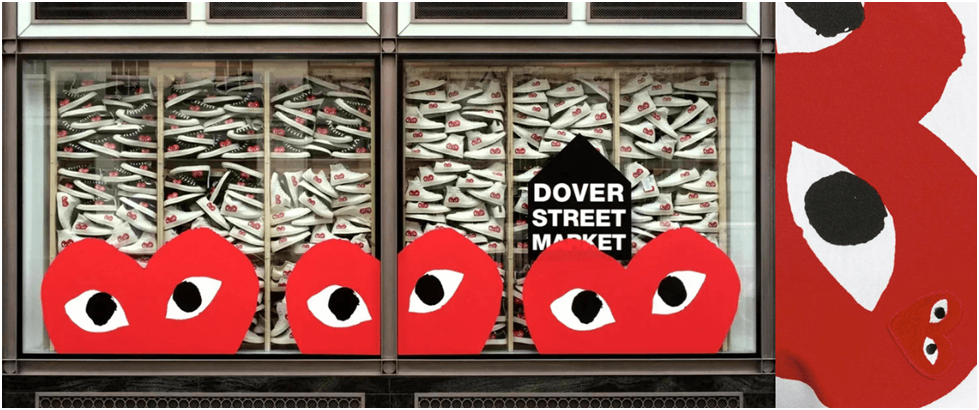
Comme des Garcons has expanded to become a huge creative world beyond the runway. Her husband, Adrian Joffe, and Kawakubo have a business empire that is artistic, though open to innovating. Sub-labels and Collaborations: Thoughout the years Kawakabo has released several of her lines including Comme des Garcons Homme Plus, Comme des Garcons Play, Comme des GarçonsGirl and Black Comme des Garcons. The Play line logo (heart-with-eyes) by artist Filip Pagowski was a worldwide fashion icon. Retail Innovation: Dover Street Market Inauguration-
This concept store was opened by Kawakubo
Joffe transformed luxury in the retail industry. The space incorporates fashion, art, and culture in an ever-changing space where the installations are replaced regularly. Partnerships with large Brands: Nike, Converse, Supreme, or Louis Vuitton are among the companies that had partnered with Kawakubo over the years, crossing the boundary between avant-garde fashion and popular culture without losing her inimitable creative vision. The Philosophy of Rei Kawakubo: